Trust Is the Real Unlock: Why Governance Is the Brake That Lets You Go Fast
In a fast-moving, AI-shaped world, trust isn't the soft side of the work. It's what decides whether the work goes anywhere at all.
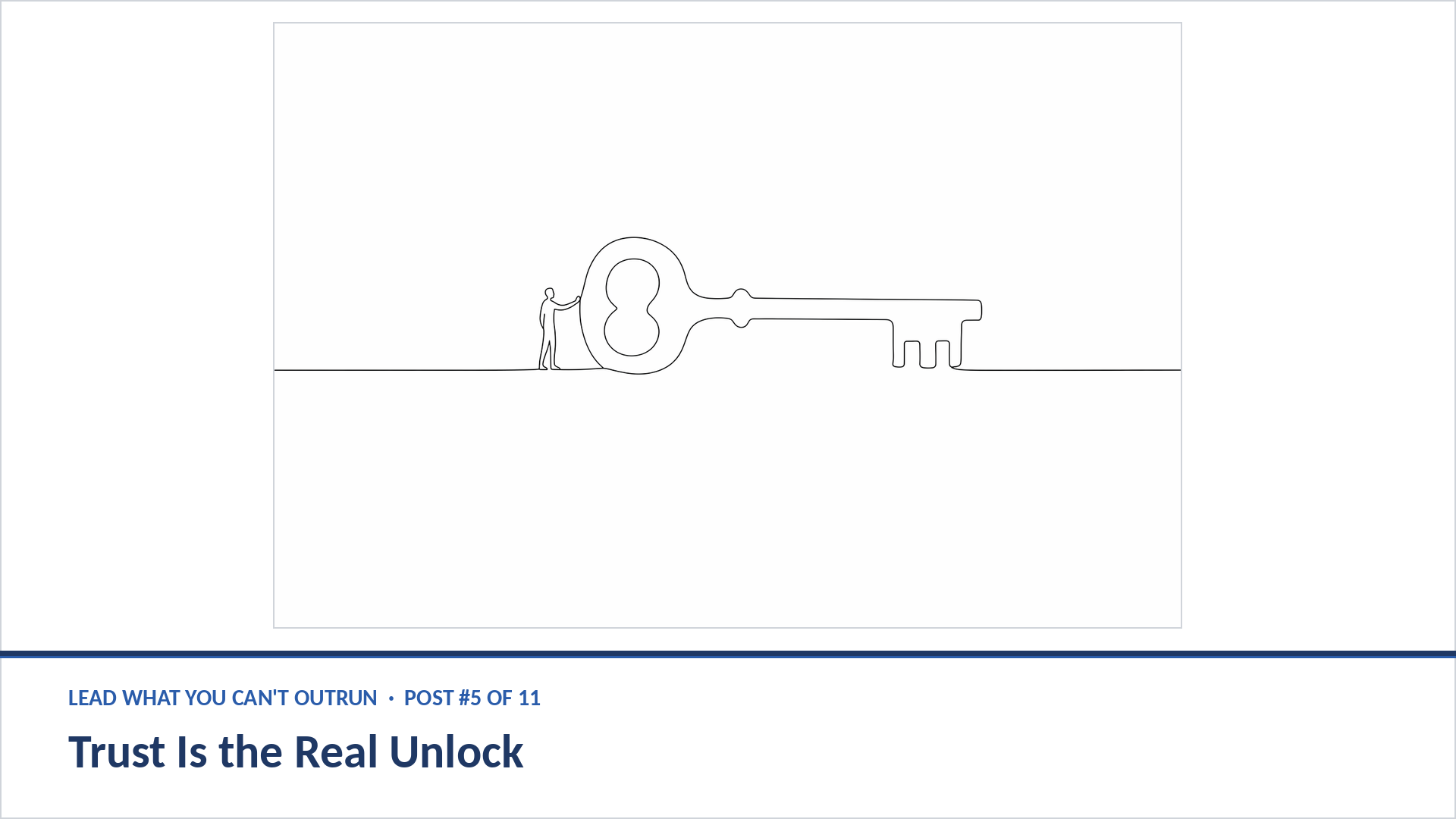
The hinge of the whole thing
Chapter 4 ended on a single word: trusted. You can build the sharpest judgement in your industry, but if no one trusts your team enough to let its work near a real decision, that judgement never gets to matter. Capability gets you to the door. Trust is what opens it and keeps you there. Nowhere is this clearer than in my field: I've watched excellent, AI-enabled security solutions stall, not because they didn't work, but because a customer, a board or a regulator wasn't yet willing to trust them. And I've watched more modest solutions sail through, because the team answered the trust questions before they were asked.
Adoption dies in the trust gap
There's a gap in every organisation between what's technically possible and what people will actually permit. AI has widened it dramatically, because the technology now runs far ahead of most organisations' confidence in it. The blocker is rarely "can we?" It's "dare we, and who'll be comfortable if we do?" Microsoft's 2026 research puts a number on it: only around one in four people say their leadership is clearly and consistently aligned on AI. That means for most teams there's no clear signal from the top about what's safe, what the guardrails are, or where the line sits. In that ambiguity, sensible people do the sensible thing, they wait. Adoption stalls not because the tools are weak, but because nobody made it clear it's safe to proceed.
Security is not the brake. It is what lets you go fast.
Here's the reframe that changes everything and one security people understand instinctively. A racing car's brakes don't exist to make it slow. They exist to make it possible to go fast, because a driver who trusts the brakes will commit to the corner. Governance, security and responsible-AI practice are the brakes. Done badly, they're friction. Done well, they're precisely what gives a team the confidence to move quickly, because everyone knows the guardrails will hold.
The leaders who win the AI era stop treating security as the department that says no and start treating it as the capability that makes yes possible. You answer the trust questions early and visibly, where does the data go, who can see it, how do we secure and control it, will this stand up to an audit, so they stop being objections and start being reassurances. The fastest adoption I see isn't where governance is absent. It's where governance is good enough that people trust it and then (almost) forget about it.
Generative cultures move bad news towards the light
Trust inside a team has a measurable shape. The researcher Ron Westrum studied how organisations handle information and found three broad cultures: pathological, where bad news is punished and so gets hidden; bureaucratic, where it's tolerated but ignored; and generative, where it's actively sought out because finding problems early is how you stay safe. Generative cultures perform better precisely because information flows towards the truth rather than away from it.
This matters more than ever with AI in the mix. When an AI-assisted decision carries real risk, you desperately want the person who spotted the flaw to feel safe saying so before it ships, not after the incident review, or after the customer has signed. Trust lost in a heartbeat takes a lifetime to recover. A team where people quietly suppress their doubts about an AI output isn't a fast team; it's an accident waiting to be written up. Building trust internally, making it safe to raise the risk, is what makes it safe to move quickly externally.
Build trust on purpose
Trust is built, deliberately, through repeated behaviour. A few moves that work:
- Make the guardrails visible. People move faster when they can see the edges. Spell out plainly what AI may and may not be used for, with what data, and where a human must sign off.
- Answer the trust questions before they're asked. Treat data, control, auditability and accountability as part of the proposal, not objections to handle later. Pre-empting them turns a sceptic into a sponsor.
- Earn trust on small, reversible things first. Build a track record on low-stakes, easily-undone uses before asking anyone to trust AI with something consequential. Confidence compounds from evidence, not assurances.
- Keep a named human accountable. Visible human accountability is itself a trust signal, it tells people there's a person, not just a process, standing behind the outcome.
- Be transparent about what the AI did. Hiding the machine's involvement erodes trust the moment it's discovered; being open about where AI helped, and how its work was checked, builds it.
The shift
Trust is the quiet multiplier on everything else. A team with judgement but no trust produces good work no one acts on. A team with trust earns the permission to move at the speed the moment demands. And the leader is the source of it.
But there's a second kind of trust, not whether your customers trust your AI work, but whether your own people trust that it's safe, and worthwhile, to change how they work at all. Because in most organisations, the people are ready long before the organisation is. That's post 6.
This post first appeared on LinkedIn, where the conversation carries on in the comments. Join the discussion ↗