Judgement Just Got Expensive: The Skill AI Made More Valuable, Not Less
The teams that win the AI era won't be the ones that produce the most. They'll be the ones that judge the best.
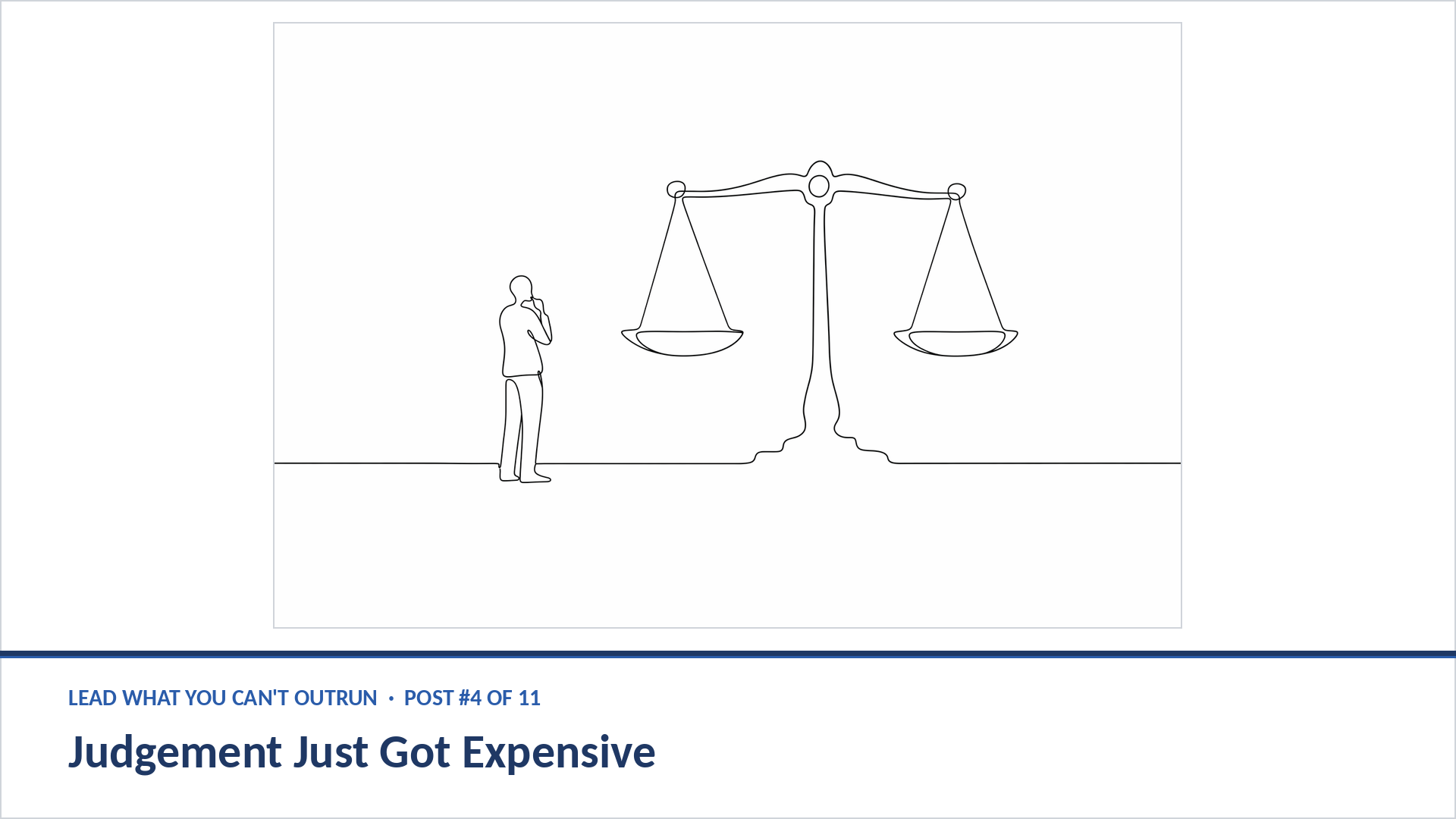
The bottleneck moved
For most of the average person's working life, the bottleneck was production. Making the thing, the analysis, the deck, the remediation plan, was the hard part, and where expertise lived. We organised teams around the people who could produce. AI has quietly moved that bottleneck. When a capable model can draft the analysis in seconds, producing the first version is no longer the scarce step. What's scarce now is knowing whether what it produced is any good. The work moved from making the thing to judging the thing and judging is harder to fake, harder to delegate, and far easier to skip.
The work moved, and the value moved with it
Start with what AI is actually used for. A privacy-preserving analysis of more than 100,000 conversations in Microsoft 365 Copilot found that roughly half, 49%, supported cognitive work: analysing, solving problems, evaluating, thinking. This is AI moving into work that used to require deep expertise. Microsoft's researchers call it a move "from expertise to agency": AI is expanding who can do high-value work. In the research, two-thirds of AI users said it lets them spend more time on high-value work, and well over half said they were producing work they simply couldn't have a year ago. Like, completing all the research for a LinkedIn series!
Read one way, AI is a gift, your whole team just levelled up. Read another, it's a warning. Because if anyone can now generate senior-level output, the thing that separates good work from dangerous work is no longer the ability to produce it. It's the judgement to tell the difference. The production got democratised. The discernment did not.
Information got cheap. Judgement didn't.
A model will give you a confident answer to almost anything, instantly, in fluent prose. The marginal cost of an answer has collapsed. But the cost of a wrong answer hasn't moved. In my world, that asymmetry is stark: an AI tool can draft a security remediation plan that reads impeccably, structured, authoritative, complete, and quietly misclassify a control, miss a dependency, or assume an architecture the customer doesn't have. The plan looks like expert work. Acting on it without scrutiny is how you turn a fluent draft into a real incident. The output was cheap; being wrong is not.
So, the scarce, valuable skill is no longer generating the answer. It's the judgement to ask: is this actually right, and would I stake a decision on it? Microsoft's 2026 research bears this out, asked which human skills matter most as AI takes on more work, people named quality control of AI's output (50%) and critical thinking (46%) above creativity or speed.
Why fluent is not the same as right
Daniel Kahneman's frame explains why judgement is so easy to skip. In Thinking, Fast and Slow he described System 1, fast, automatic, intuitive, and System 2, which is slow, deliberate, and the part of us that actually checks. AI output is engineered, in effect, to satisfy System 1: fluent, confident, immediate, exactly the qualities our fast brain reads as true. Confidence and correctness feel the same from the outside. Left to our defaults, we wave it through, because engaging System 2 requires time and effort. The quiet risk in every AI-augmented team isn't that the technology is often wrong, it's that when it's wrong, it's persuasively wrong. Encouragingly, 86% of AI users already say they treat AI's output as a starting point, not a final answer. I would argue, the job of a leader is to turn that instinct, held by some, into a discipline held by all.
Building judgement into a team
Judgement is a habit you can build, and it's the system around your people, not any individual, that decides whether it takes hold. A few moves:
- Make verification the norm. Apply a simple, consistent check to any significant AI-assisted output before it informs a decision: Am I treating this as a starting point or the answer? What would I check if a junior handed me this? Can I verify the key claims against a source? Who owns the consequences if it's wrong?
- Reward the catch, not just the output. Celebrate the person who noticed the confident answer was subtly off. If finding flaws is treated as friction, people stop looking.
- Teach specific scepticism. "Be critical" doesn't stick; domain-specific scepticism does. Know the three things an AI plan most often gets wrong in your field, and check those first.
- Slow down the decisions that deserve it. A first-draft email doesn't need System 2. A customer-facing risk assessment or legally binding document does.
Someone still owns the call
One principle anchors all of it: a human still owns the decision, and the accountability that comes with it. "The tool recommended it" is not cover. The model can inform the decision; it cannot own it. The faster the machine, the clearer the human accountability needs to be.
That word, trusted, is the bridge to post 5. Judgement is what makes the work good. Trust is what lets it move.
This post first appeared on LinkedIn, where the conversation carries on in the comments. Join the discussion ↗