Will your team outlast what they can't outrun? And the One Step that follows
A take on two questions, and a free place to work through them.
The question we avoid
Most of the managers and leaders I talk to are working through the same thoughts, concerns and changes they need to make in the new world of working with AI. The only problem with this is finding a quiet moment to ask the honest question: where is my team, actually, right now? Not where it should be. Not where the strategy says it is. Where it genuinely is, this week, in the middle of everything.
It can be an uncomfortable question, and most of us avoid it for two very human reasons. The first is that we're moving too fast to stop and ask it. The second is that the honest answer is rarely as flattering as the one we carry around in our heads. When you finally find the time to look, you may find your team a stage or two behind where you'd assumed. If that's you, as it was (and still is!) me: that isn't a failure, and it isn't a verdict on you or on them. It's the single most useful thing you can learn, because you cannot move a team forward from a place you haven't honestly named.
Locate yourself before you move
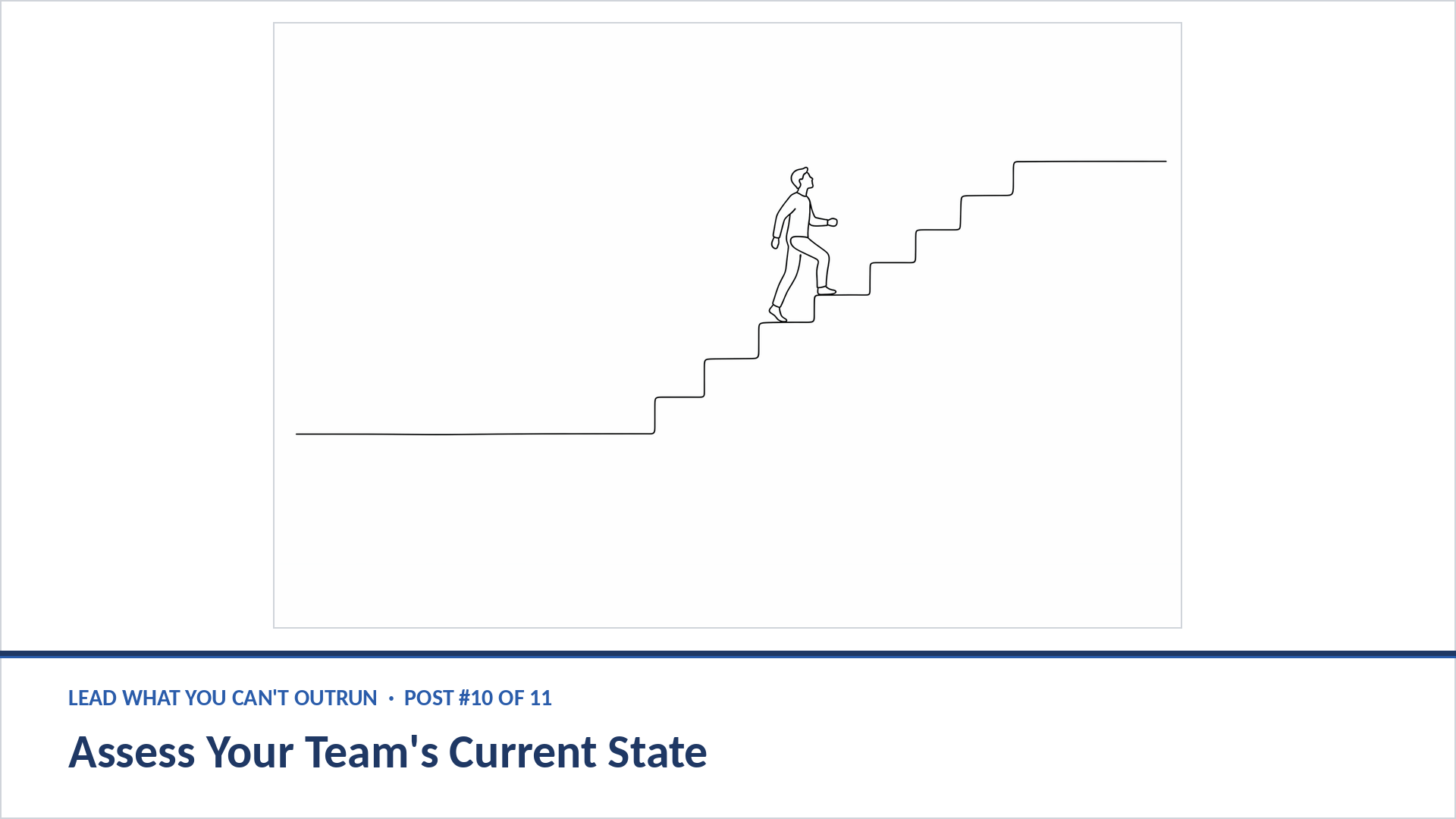
I've come to think of this as locating yourself before you move. A map is no use until you know where you're standing on it. And the locating is harder than it sounds, precisely because we're all a little too close, a little too invested, and a little too tired to see clearly. The managers and leaders who assess their team most honestly aren't the most pessimistic ones. They're the ones who've made peace with the idea that an honest starting point is a gift, not a criticism.
You don't have to fix everything
Here's the part I always find reassuring. Once you know where you are, you do not have to fix everything. In fact, trying to is the fastest way I know to burn out the very people you're trying to help. The instinct, when we finally see the gap, is to close all of it at once: new habits, new tools, new expectations, starting Monday. It rarely works. Faced with everything at once, the most rational response a busy team can have is to do none of it, or at least none of it well.
What works is sequence. One ordered step, then the next. You cannot build sharp judgement on a team that can't yet finish what it starts, and you cannot ask people to reinvent how they work before they trust it's safe to try. So the order matters as much as the effort, and the good news hidden in that is permission: we're allowed to do one thing well before we reach for the next. That isn't going slow. It's the only pace that actually compounds.
Where the work now lives
All of what I have shared so far is theory, backed up by evidence and experience, but still theory. So, I landed on a model that I hope is also useful to you, in a tool, which you can use to help with "the" question, once you have time to ask it.
There are two small tools, and they're open to anyone. The first is a short readiness assessment: sixteen honest statements that give you a sense of where your team stands today and, more usefully, the single thing most worth working on first. The second turns that into a simple 90-day plan, which you can run as many times as needed. Nothing captured, everything you put in stays local to you.
You'll find them at cantoutrun.com/tools, alongside the full series in a freely downloadable copy. If you find this useful let me know, if you see ways it can be improved, also let me know.
I have one more article in this series to share next week, that's post 12, the conclusion "The Leader is the Lever".
This post first appeared on LinkedIn, where the conversation carries on in the comments. Join the discussion ↗