The Leader as the Lever: What the Whole Series Comes Down To
Series finale. The fragmented, exhausting Tuesday isn't your team's fate. It's a design problem you're uniquely placed to solve.
Back to that Tuesday
We began with an ordinary Tuesday: a capable team, working flat out, and somehow never quite getting things fully finished. The journey of this series has been an attempt to explain why, and what a leader can actually do about it.
The ground has shifted under all of us. Work has become faster, more fragmented and more demanding, and into that already-stretched world arrived an exponential technology that most teams are only beginning to grasp. The natural response (to run harder, add more, chase every ask or task) makes it worse. The argument, throughout, has been that the winning response is the opposite one: to subtract. To protect attention rather than fragment it. To finish rather than start. To curate rather than forward. To make it safe to change. And to treat focus, judgement and trust as the scarce resources they have become.
The single spine
We traced that argument through one spine. Attention is the real constraint, and a clear mission directs it (Article 2). Closure protects it (Article 3). As AI reshapes the work, judgement becomes the scarce skill (Article 4), trust the thing that lets good work move (Article 5), and the leader's task becomes closing the gap between ready people and an unready organisation (Article 6). Teams now include agents as well as people (Article 7); the durable human advantage is the ability to keep learning (Article 8); and none of it is sustainable without a pace that doesn't consume the people it depends on (Article 9). Finally, we turned all of it into something you can assess and act on (Articles 10 and 11).
The one finding to carry
Underneath every chapter ran one finding, and it's the one to carry out of this series. The biggest determinant of whether a team thrives in the AI era is not the talent of its individuals or the tools they are given. It's the system around them, and you are the architect of that system.
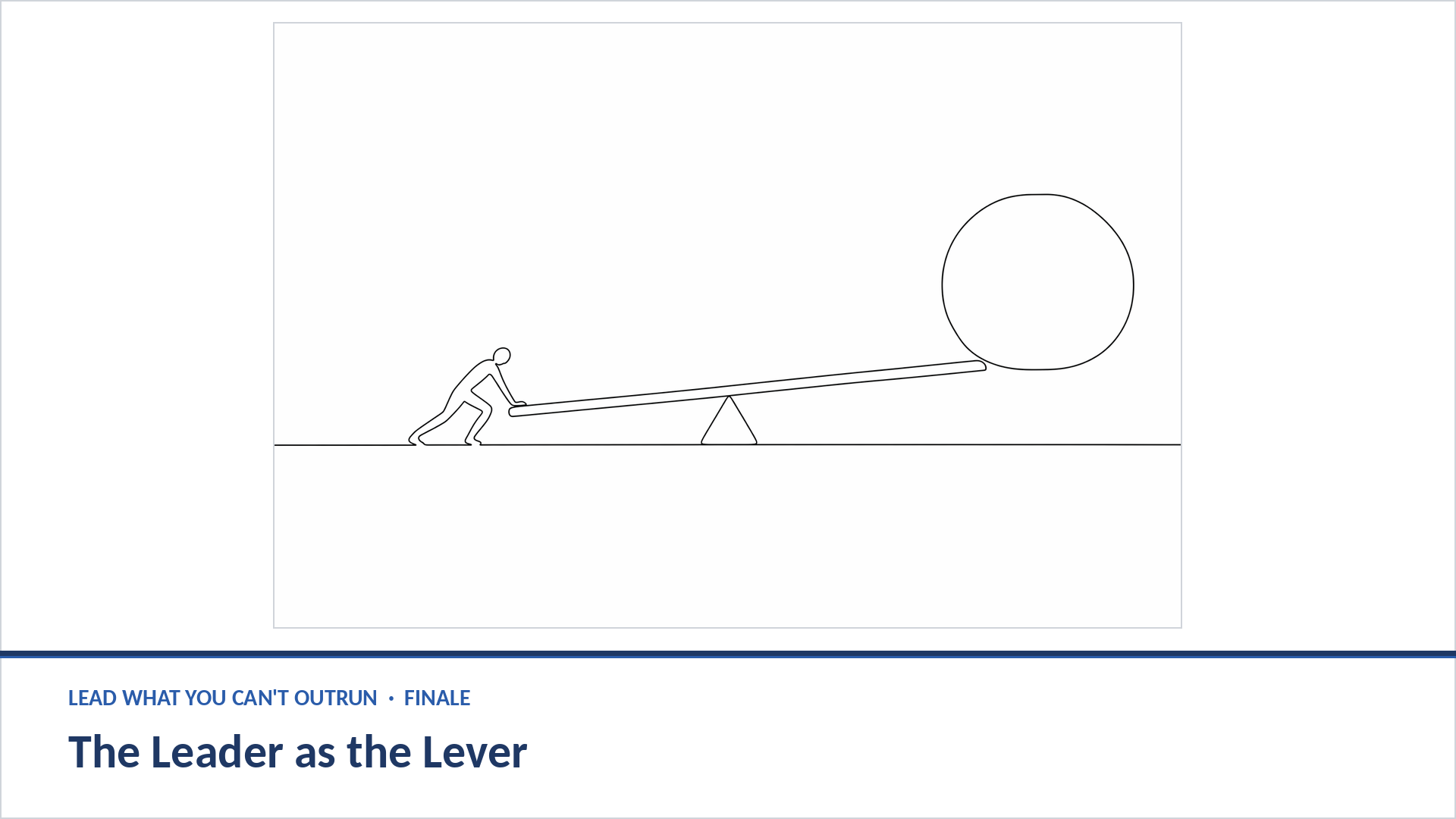
The leader is the lever.
That's a weight and a gift in equal measure. It means the fragmented, exhausting Tuesday is not your team's fate, but a design problem you are uniquely placed to solve. In an age obsessed with individual productivity hacks, the highest-leverage move available to you isn't a new tool or a harder push. It's the deliberate design of the conditions your people work in.
What deliberate leadership looks like
You cannot out-run an exponential. No leader can, I am sure we have all tried to at some point, and the ones who exhaust themselves trying take their teams down with them. But you can do something better than out-run it. You can lead deliberately within it: deciding what matters, protecting the focus to pursue it, and giving your people the clarity, safety and trust to do their best work while the world keeps moving.
That's the difference between a team that's chased by the pace and a team that's led through it. Not more effort. More intention.
Do one thing
So don't try to do all of this at once: that would be to make the very mistake the series warns against. Do one thing:
- Pick a single team.
- Write its mission in a sentence.
- Name the one thing it will stop doing this week.
Everything else in these pages builds from that first act of subtraction. Anyone can add. In a world that will not stop accelerating, the leaders who win are the ones with the discipline to subtract, and the wisdom to know that leading what matters was always the point.
Thank you
Thank you for following this serialisation of Lead What You Can't Outrun. If it reframed even one problem you're facing, or nudged you in a better direction, I would be grateful to know and it would have been worth it! The full series/book goes deeper still: the complete four-stage Team Readiness Assessment, the Leader's Toolkit (six ready-to-use tools) and the full evidence base behind every figure in the series. Download on cantoutrun.com/tools
Now I need to spend my time on getting the next series sorted! Outlast What You Can't Outrun, turns inward: to how you sustain yourself in all this. But that's a series for another day.
Stop trying to keep up. Start leading what matters.
This post first appeared on LinkedIn, where the conversation carries on in the comments. Join the discussion ↗