Leading Humans and Agents: The New Discipline Hiding in Your Org Chart
The skill is no longer only leading people. It's orchestrating people and digital labour together.
A present-tense change
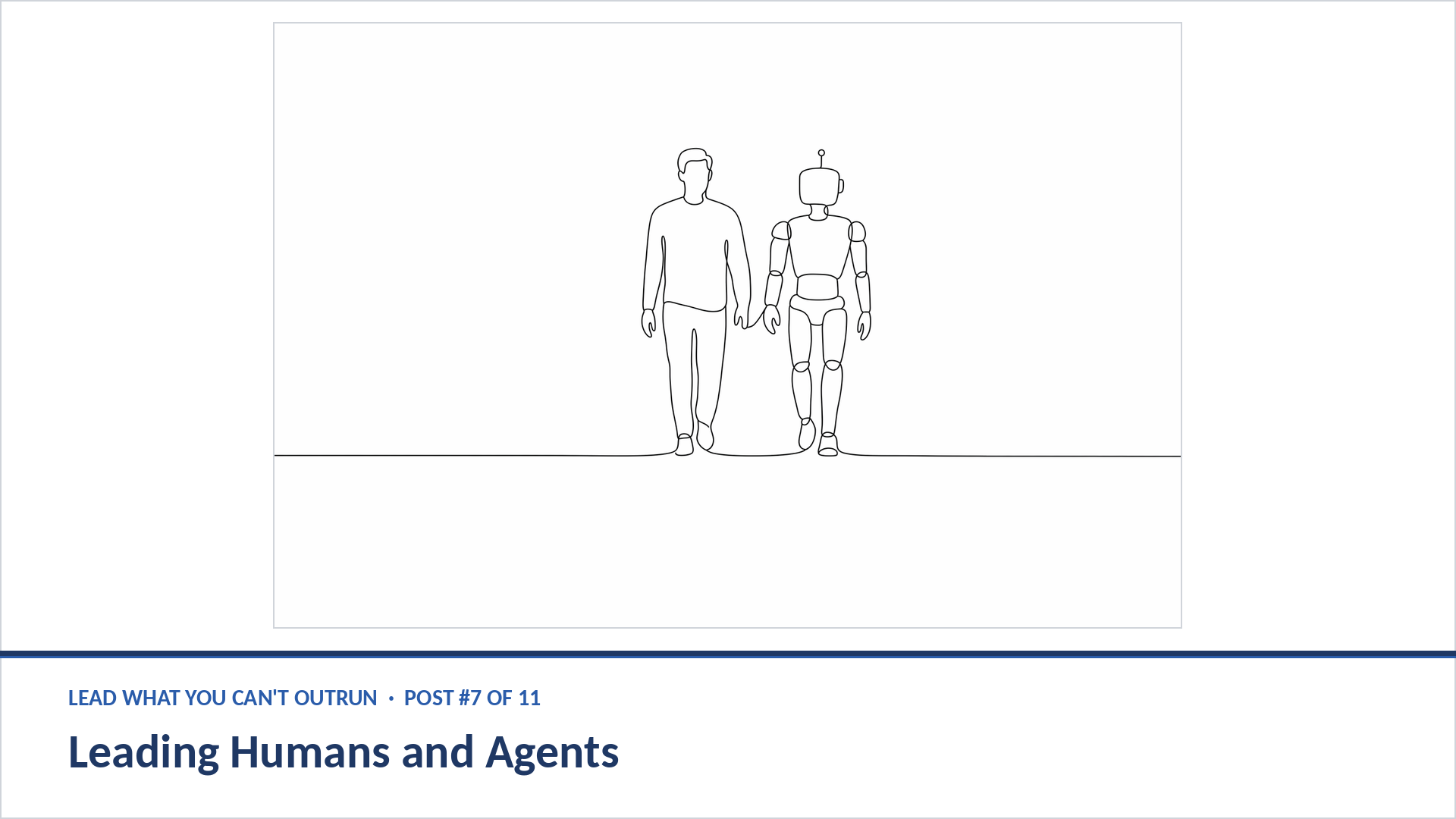
For your entire career, the people you led were people. That assumption is quietly ending. The fastest-growing members of many teams are no longer human at all: AI agents that can reason, plan and carry out multi-step work with a degree of independence. In Microsoft's ecosystem, the number of such agents grew roughly fifteen-fold in a single year, and nearly half of leaders now say their organisation is using agents to automate at least one workflow outright. The org chart is starting to include workers who don't sleep, don't attend the team meeting, and don't exist on the payroll. This isn't a distant scenario; it's a present-tense change in what management means. The skill is no longer only leading people: it's orchestrating people and digital labour together, and that's a genuinely new discipline without a rule book.
From org chart to work chart
Microsoft's researchers describe a shift from the rigid org chart, organised around who reports to whom, to a more fluid "work chart," organised around the jobs that need doing and staffed with whatever mix of humans and agents gets them done. They sketch a three-phase journey most teams will travel: first AI as an assistant, helping people do their existing work faster; then agents as "digital colleagues," taking on specific tasks under human direction; and finally humans setting direction for agents that run whole processes, checking in at the moments that matter. Most organisations will be in all three phases at once, in different corners of the team. The leader's job isn't to pick a phase but to design the right blend for each piece of work, and to keep redesigning it as the agents grow more capable, which they will, quickly.
The human–agent ratio
That design question deserves a name, and Microsoft gives it one: the human–agent ratio. For any given workflow, two questions decide it. How many agents do we need, for which tasks? And how many humans do we need to guide, check and stand behind them? Get the ratio right and you scale a small team's impact enormously. Get it wrong, too few humans guiding too much autonomous work, and you scale your mistakes just as fast. The answer is always task-specific. Some work is genuinely better done by human and machine together. Some work customers simply want a person for. And some decisions are ones society, or a regulator, expects a human to be answerable for, however capable the agent. Setting the ratio isn't a one-off configuration; it's an ongoing act of judgement about where the line between human and machine should sit, this quarter, for this job.
What to keep firmly human
If agents take on more of the execution, the question every leader must answer is what stays human, and the answer is strategic, not sentimental. Keep human the things humans are uniquely accountable for and uniquely good at: the judgement to tell good work from plausibly-wrong work (post 4); the relationships that carry a customer through change; the ethical calls; and ownership of any decision that's high-stakes or hard to reverse. The customer handshake and coffee conversations that keep work and relationships real.
Lead the agents like you lead a new hire
Here's a reassuring truth: much of what you already know about leading people transfers. An agent, like a capable but very literal new joiner, needs a clear goal, a defined quality bar, supervision of its early output, and a feedback loop that catches and corrects mistakes. The teams that struggle hand an agent a vague instruction and trust the confident-looking result: the very System 1 trap from post 4, now operating at machine speed. The teams that thrive direct their agents as deliberately as they would a new member of staff, and review the work just as carefully.
One warning carries over with particular force: do not automate a broken process. AI can simply accelerate a flawed system, and an agent pointed at a messy, unclear workflow will produce mess faster and at greater scale. Finish the work of posts 2 and 3 first (clarify the mission, close the loops, cut the clutter), and then hand the clean, well-understood process to an agent. Automate the thing once it's worth doing, not before. Get this right, or as near to right as you can at the start, saves a heck of a lot of work trying to resolve.
The shift
Leading humans and agents isn't a futuristic specialism, although it can feel like it to many; it's rapidly becoming the core of the job. It asks you to design the blend, set the ratio, protect what must stay human, and direct your digital colleagues with the same attention you give your human ones, all while keeping the system, not any single worker, as the thing you're really managing.
But every one of those judgements depends on people who can keep learning faster than the agents around them change. Which makes the next question a hiring and growing one: how do you build a team of learners? That's post 8.
This post first appeared on LinkedIn, where the conversation carries on in the comments. Join the discussion ↗