It's Not Effort. It's Attention. The One Instrument That Directs It
Speed without clarity just creates motion. A real mission creates progress.
The wrong lever
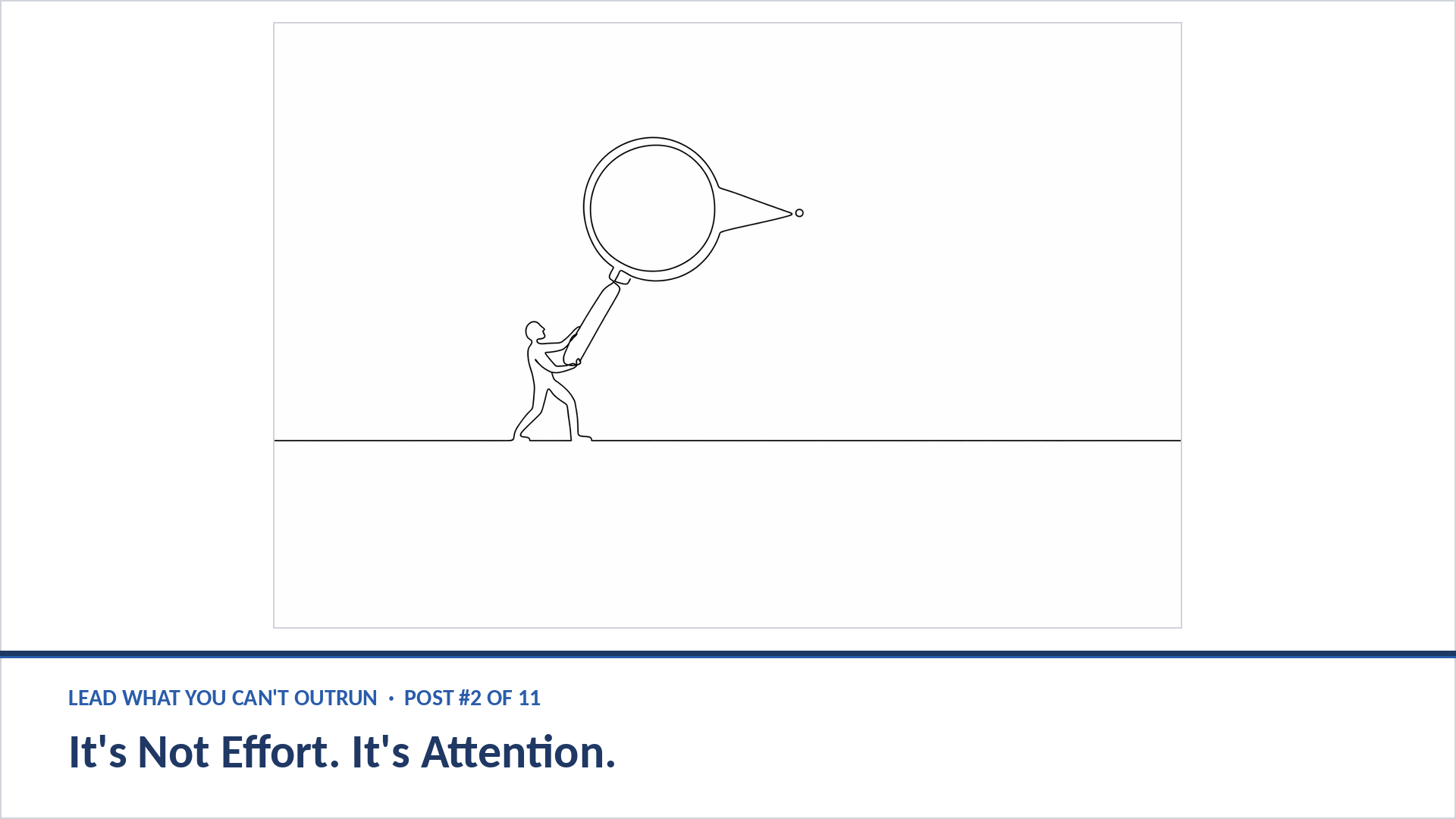
There's a temptation, when a team is underperforming, to reach for the effort lever, longer hours, more check-ins and inspection, a motivational push. We assume that if output is down, commitment must be too. It's almost always the wrong diagnosis. The teams I see struggling aren't lazy. They're scattered. Their effort is real; it's just sprayed across so many directions that very little of it accumulates into real progress. In a world that interrupts the average worker every two minutes, the bottleneck was never how hard people push. It's where their attention goes.
What a mission actually is
The single most powerful instrument a leader has for directing attention is a mission, and I mean something precise, real clarity, real direction. A mission in this context is not a grand company statement. It's the specific outcome a team exists to create: if we do our jobs well over the next quarter, what is different in the real world?
Compare "we aim to improve the customer experience" with "cut customer onboarding time from fourteen days to three by the end of Q3." The first is a sentiment. The second is a mission. It tells people not just what to do, but what matters most, right now, and how success will be judged. And crucially, it isn't step-by-step instruction, it's clarity on the objective, with the team empowered to find their own path. That empowerment is what drives delivery.
Why it works, the evidence
This is not folklore. Decades of research by Edwin Locke and Gary Latham established that specific, challenging goals consistently outperform vague "do your best" instructions and the reason is exactly the point of this chapter. Clear goals direct attention toward what matters and away from what doesn't. They energise effort, sustain persistence, and prompt people to find better strategies. Ambiguity does the reverse: it lets attention pool wherever the loudest or most recent ping happens to be.
A mission-first team has a shared answer to four simple questions: What are we here to achieve? What matters most right now? Who owns what? How will we know it's working? When everyone can answer those, attention organises itself. When they can't, no amount of effort compensates.
Clarity needs a companion: safety
Clarity tells people where to go. But in an anxious, fast-moving environment it isn't enough on its own, because people also need to be able to tell you the truth about what's in the way. This is where Amy Edmondson's research on psychological safety becomes essential. Across decades of study, she found that teams perform better not when they hide problems, but when they surface them. In one of her most counter-intuitive findings, the best-performing teams reported more errors than weaker ones, not because they made more mistakes, but because they felt safe enough to admit them, and so caught them early. Clarity points the team in a direction; safety lets them flag the obstacle before it becomes a crash.
The business case is hard to ignore
If this still sounds soft, the numbers aren't. Gallup found that, globally, only about one in two employees strongly agree they know what's expected of them, meaning half of most teams don't. Speed without clarity just creates motion. Mission creates progress.
A five-minute test you can run this week
Ask three people on your team, separately:
- What are we here to achieve?
- What matters most this quarter?
- What should we stop doing?
If the answers come back vague, inconsistent, or wildly individual, that's your signal. Start with the mission. Everything downstream gets easier when people know what matters, why, and how they contribute.
So here's the challenge from this chapter: write your team's mission in one sentence. Cut the priority list to three. Make ownership explicit. The fastest way to improve pace often isn't adding activity. It's creating clarity.
But clarity, it turns out, is only half the battle, because even a perfectly focused team can fail to finish. That's post 3.
This post first appeared on LinkedIn, where the conversation carries on in the comments. Join the discussion ↗